


About
Projects
Publications
People
News
Contact

RED(es) Presents Research at SPSP 2026 on Biculturalism and Political Attitudes
March 13, 2026
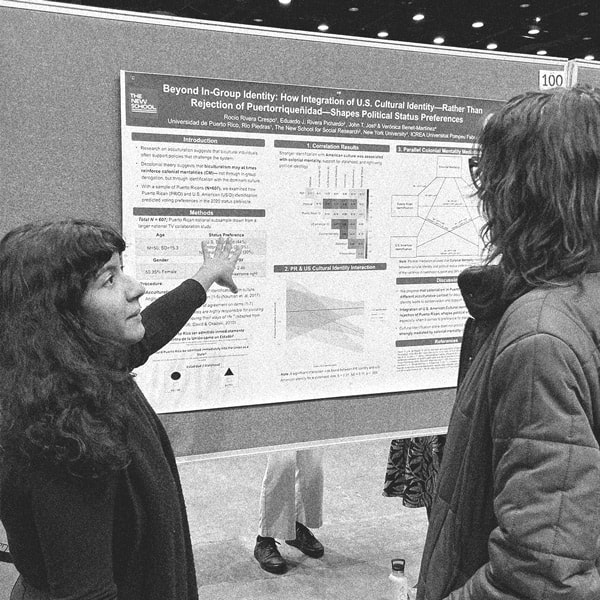
RED(es) presented work at the 2026 Annual Convention of the Society for Personality and Social Psychology (SPSP) through Rocío Rivera Crespo’s poster presentation, “Beyond In-Group Identity: How Integration of U.S. Cultural Identity—Rather Than Rejection of Puertorriqueñidad—Shapes Political Status Preferences.”
The poster was presented as part of the Group Processes and Intergroup Relations Preconference and the Critical Perspectives in Psychology Preconference.
Drawing on research on acculturation and decolonial theory, this project examined whether experiences of biculturalism within Puerto Rico’s colonial context are linked to attitudes that challenge the system or, to system-justification processes that reinforce colonial mentalities (CM). While acculturation research often suggests that bicultural individuals support policies opposing the status quo, decolonial theory proposes that biculturalism may also reinforce colonial mentality, not through ingroup derogation but through identification with the dominant culture.
Overall, the findings suggest that, in Puerto Rico’s colonial context, bicultural identity indirectly influences support for U.S. statehood and rejection of national independence through colonial mentality, which mediates the relationship between cultural identification and political status preferences.
We congratulate Rocío Rivera Crespo on this achievement and look forward to her ongoing contributions to research on coloniality, cultural identity, and political attitudes in Puerto Rico.
For more information about this project or to get involved in ongoing research initiatives and collaborations, please contact RED(es): Decolonial & Political Psychology Research Group.
Contact
The New School for Social Research
80 Fifth Avenue, 7th floor
New York, NY 10011
Decolonial & PoliticalPsychology Research Group

RED(es) Presents Research at SPSP 2026 on Biculturalism and Political Attitudes
March 13, 2026
RED(es) presented work at the 2026 Annual Convention of the Society for Personality and Social Psychology (SPSP) through Rocío Rivera Crespo’s poster presentation, “Beyond In-Group Identity: How Integration of U.S. Cultural Identity—Rather Than Rejection of Puertorriqueñidad—Shapes Political Status Preferences.”
The poster was presented as part of the Group Processes and Intergroup Relations Preconference and the Critical Perspectives in Psychology Preconference.
Drawing on research on acculturation and decolonial theory, this project examined whether experiences of biculturalism within Puerto Rico’s colonial context are linked to attitudes that challenge the system or, to system-justification processes that reinforce colonial mentalities (CM). While acculturation research often suggests that bicultural individuals support policies opposing the status quo, decolonial theory proposes that biculturalism may also reinforce colonial mentality, not through ingroup derogation but through identification with the dominant culture.
Overall, the findings suggest that, in Puerto Rico’s colonial context, bicultural identity indirectly influences support for U.S. statehood and rejection of national independence through colonial mentality, which mediates the relationship between cultural identification and political status preferences.
We congratulate Rocío Rivera Crespo on this achievement and look forward to her ongoing contributions to research on coloniality, cultural identity, and political attitudes in Puerto Rico.
For more information about this project or to get involved in ongoing research initiatives and collaborations, please contact RED(es): Decolonial & Political Psychology Research Group.
Contact
The New School for Social Research
80 Fifth Avenue, 7th floor
New York, NY 10011
Decolonial & PoliticalPsychology Research Group

RED(es) Presents Research at SPSP 2026 on Biculturalism and Political Attitudes
March 13, 2026
RED(es) presented work at the 2026 Annual Convention of the Society for Personality and Social Psychology (SPSP) through Rocío Rivera Crespo’s poster presentation, “Beyond In-Group Identity: How Integration of U.S. Cultural Identity—Rather Than Rejection of Puertorriqueñidad—Shapes Political Status Preferences.”
The poster was presented as part of the Group Processes and Intergroup Relations Preconference and the Critical Perspectives in Psychology Preconference.
Drawing on research on acculturation and decolonial theory, this project examined whether experiences of biculturalism within Puerto Rico’s colonial context are linked to attitudes that challenge the system or, to system-justification processes that reinforce colonial mentalities (CM). While acculturation research often suggests that bicultural individuals support policies opposing the status quo, decolonial theory proposes that biculturalism may also reinforce colonial mentality, not through ingroup derogation but through identification with the dominant culture.
Overall, the findings suggest that, in Puerto Rico’s colonial context, bicultural identity indirectly influences support for U.S. statehood and rejection of national independence through colonial mentality, which mediates the relationship between cultural identification and political status preferences.
We congratulate Rocío Rivera Crespo on this achievement and look forward to her ongoing contributions to research on coloniality, cultural identity, and political attitudes in Puerto Rico.
For more information about this project or to get involved in ongoing research initiatives and collaborations, please contact RED(es): Decolonial & Political Psychology Research Group.
Contact
The New School for Social Research
80 Fifth Avenue, 7th floor
New York, NY 10011
Decolonial & PoliticalPsychology Research Group

RED(es) Presents Research at SPSP 2026 on Biculturalism and Political Attitudes
March 13, 2026
RED(es) presented work at the 2026 Annual Convention of the Society for Personality and Social Psychology (SPSP) through Rocío Rivera Crespo’s poster presentation, “Beyond In-Group Identity: How Integration of U.S. Cultural Identity—Rather Than Rejection of Puertorriqueñidad—Shapes Political Status Preferences.”
The poster was presented as part of the Group Processes and Intergroup Relations Preconference and the Critical Perspectives in Psychology Preconference.
Drawing on research on acculturation and decolonial theory, this project examined whether experiences of biculturalism within Puerto Rico’s colonial context are linked to attitudes that challenge the system or, to system-justification processes that reinforce colonial mentalities (CM). While acculturation research often suggests that bicultural individuals support policies opposing the status quo, decolonial theory proposes that biculturalism may also reinforce colonial mentality, not through ingroup derogation but through identification with the dominant culture.
Overall, the findings suggest that, in Puerto Rico’s colonial context, bicultural identity indirectly influences support for U.S. statehood and rejection of national independence through colonial mentality, which mediates the relationship between cultural identification and political status preferences.
We congratulate Rocío Rivera Crespo on this achievement and look forward to her ongoing contributions to research on coloniality, cultural identity, and political attitudes in Puerto Rico.
For more information about this project or to get involved in ongoing research initiatives and collaborations, please contact RED(es): Decolonial & Political Psychology Research Group.
Contact
The New School for Social Research
80 Fifth Avenue, 7th floor
New York, NY 10011
Decolonial & PoliticalPsychology Research Group